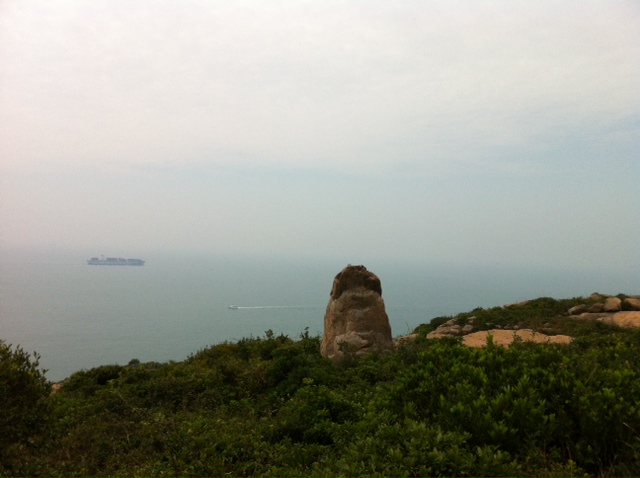
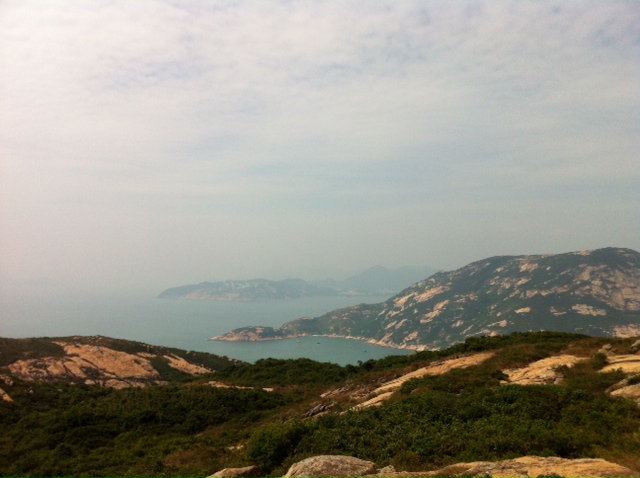
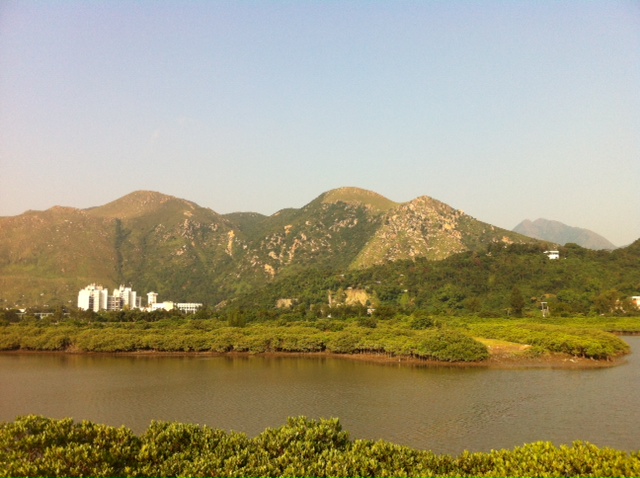
Route: from Ma On Shan Village (馬鞍山村)to Shui Long Wo(水浪窩) 
Length: 8 km
The number of hours taken: 4 
Date: 24 December, 2011I was mesmerized by this hiking trail which offers breathtaking mountain view and enchanting and unique landscape of Hong Kong.

To arrive at Ma On Shan Village, the starting point, the easiest way is to take taxi from Ma On Shan MTR station (HK$40). Tell the driver that you want to get to the terminus of the village bus (NR84).

The bus village only operates three times in the morning (8am, 9am, and 10:30am) between the village and Sunshine City Bus Terminal (新港城巴士站),near the Ma On Shan MTR station. Bus fare is HK$5.

the intersection

There is a staircase next to the village bus terminus. Follow it and start your trekking. After about 20 minutes, you will come to an intersection with a pavilion, the start of the MacLehose Trail. Go the direction of Kei Ling Ha (企嶺下). This also marks the start of the MacLehose Trail’s fourth section. MacLehose Trail is a hiking trail that crosses much of New Territories, named after the longest serving Hong Kong governor Crawford Murray MacLehose.

You will soon start the ascent of a hill after leaving the intersection. The ascent is not steep, not a difficult climb.

the path after leaving the intersection

When you come to the top, you see Pyramid Hill (536m) at your right and Wan Cook Shan (Winding Hill, 592m) at your left. What a view here! The hills further from the Winding Hill are Ma On Shan (Saddle Hill,702M ).

Overlooking Ma On Shan town

Looking back at Pyramid Hill

On Winding Hill, towards Ma An Shan

The weeds at the foothill of Ma On Shan

Winding Hill with Ma On Shan at the edge

At the foothill of Ma On Shan, there is a sign pointing to Shui Long Wo. Follow it or you will have to ascend Ma On Shan. From here it is all downhill.

A glimpse of Sai Kung on the way going downhill

You will walk a tree lined path before you come to a concrete road which is the area of Wong Chuk Yueng (黃竹洋). Turn right and carry on.Then a television antenna tower appears. In its shadow lies the Chuk Yueng Road (竹洋路).Follow Chuk Yueng Road to go downhill. At the first intersection, turn left to the “Kei Ling Ha Forest Track”. There is a barricade at the start of the track to prevent vehicles from entering. So it is easy to recognize.
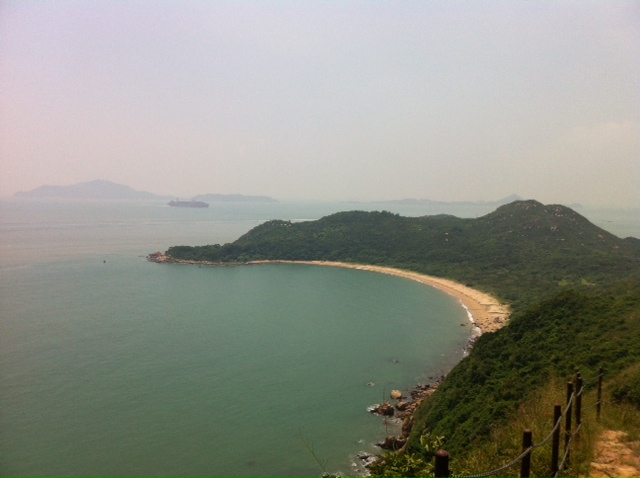
the Forest Track leading to Sai Sha Road

It takes about 20-30 minutes before you finally reach Sai Sha Road (西沙路) after passing by a camping site and a bbq site. At Sai Sha road, you can take No. 99 or No. 299 bus to Shatin, or Wu Kai Sha MTR station (all in one direction, with the bus stop at the side of your exit from the MacLehose Trail) or to Sai Kung, the opposite direction.


Date: 17 December, 2011;Sunny
Route: Brown Walk, Tai Po Kau Nature Reserve

This place is a pleasant surprise for me. It is the best place in Hong Kong to observe bird populations of forests, and it is the first secondary forest in Hong Kong, I later learnt.

No wonder this scene is commonplace in the Reserve. So many people have come here for bird watching, including a few Japanese visitors, and for photography.

Hong Kong Government started the reforestation work in Tai Po Kau in 1926. Initially the species Chinese Red Pine was most common. Local villagers therefore named the place pine garden, or Tsung Tsai Yuen (松仔園)in Chinese. The place was declared a Nature Reserve in 1977 and the plant species has grown to over 100 now.

The place is so lush and peaceful, will vibrant biodiversity. I totally enjoyed the walk.Four walking trails of varying lengths have been designed for walkers – Yellow Walk-10km; Brown Walk-7.5km; Blue Walk-4km; Red Walk – 3km. I chose the Brown Walk, which according to the signs, can be completed in two and a half hours. But I could only finish it in three and a half hours. With trees providing shade all along, the trails here are no doubt ideal for summer walk.

the red in the forest

bamboo trees

a tree grows on the rock

a monkey resting on the bench

How to get to starting point
Take the minibus No.28k in Tai Po MTR Station, get off at Tsung Tsai Yuen (松仔園). Buses No. 72,72 A, 73A, 74A also pass by Tsung Tsai Yuen.

Tell the minibus driver that you get off at Tsung Tsai Yuen. The fare would be HK$5. Otherwise, you will be charged the full fare of the minibus.

the bus stop at Tsung Tsai Yuen

You will be dropped off at this bus station at Tsung Tsai Yuen on Tai Po Road. Walk a few steps towards the taipo direction, and you will see the entrance to and sign saying “ Tai PO Kau Nature Reserve”.

It is a 15-minute walk from the entrance to the starting point where a map and routes of the different walks are posted.

How to return to Taipo
Take the bus or minibus on Tai Po Road, in the direction of Tai Po.


Hoi Ha Wan

If you want to see some of Hong Kong’s most charming sea scenery, then you must hike this route. It mostly skirted the coast, unveiling first the Long Harbour and then Hoi Ha Wan, a protected and sheltered bay which is named Hoi Ha Marine Park because of its conservation value.

Route: Tai Tan Country Trail (大灘郊遊徑) 

Hoi Ha Road (near Tau Tong Kai猴塘溪) – Tai Tan (大灘) – Sze Tei (獅地)– Chung Sha Teng (涌沙頂) – Lo Tsai Shek (爐仔石)– Lan Lo Au (攔路坳)– Hoi Ha (海下)

When you start, you can see this view:Then you pass Tai Tan Village, commanding quiet water and mountain views:

view near Tai Tan

view from Tai Tan village

Near midway, you will come to a beach.  After the beach, it is a continuous climb. Not easy. And the path is dotted with rocks!

But you will be rewarded with this scenery at the top:

Sharp peak, known for its steepness, stands out in sharp relief

And then, I met three cows which occupied the narrow path in front of me. (That explains the cow dung along the way.) I mustered all my courage and managed to walk past them without irritating them, luckily.

Going downhill, I had the first glimpse of Hoi Ha Bay:You will then come to the intersection with Wan Tsai Peninsula which houses some modern campsites. From the intersection is about half an hour before you reach Hoi Ha Village where there are small family-run shops selling drinks and noodles.

How to get to starting point:

Take minibus No.7 from Sai Kung which goes to Hoi Ha. Get off at Hoi Ha Road where the trail “Tai Tan Country Trail” starts. Or get off at Hau Tong Kai bbq site. And then walk against the direction of Hoi Ha for two minutes on Hoi Ha Road before you can see the starting point of the trail.Total hours: 3.5 hours

Length: 7.3km

Always follow the sign to Hoi Ha or the “walker” trail sign, and you will find your way.

How to get back to Sai Kung

Take No. 7 minibus going back to Sai Kung from Hoi Ha Village. The stop at the village is the terminus for the minibus.

Map of the Route


Hiked on 2 December, 2011. Weather: Fine. Route: Tseng Lan Shue (井欄樹) to Tsz Wan Shan (慈雲山)

This is one of the most memorable hikes I’ve ever done. Highly recommend it.

First part of the trail: from Tseng Lan Shue (井欄樹) to Tai Lam Wu (大藍湖)

This part of the route is also called Sai Kung Old Path(西貢古道), dating back to old times when residents in Sai Kung used the path for going to Kowloon. It is one of the most pleasant routes I have hiked. See the video below:

Lush trees line the dirt or stone-paved paths, with singing streams and birds. Some tree roots branch out extensively to form steps.

The red in the green:

Second part of the trail: Ascend Tung Yeung Shan (東洋山,about 570 metres)

When you come out of the “Sai Kung Old Path”, you will find yourself land on a concrete road. Follow the road to Tai Lam Wu village, a small settlement. Once you have passed by it, you will soon see a sign and path at the left leading up to the “Wilson Trail” and a strenuous hike will soon commence.

The  hike up the near 580 metre-high Tung Yeung Shan is all steps and steps. However once you bring yourself up to a higher point, you can see this wonderful view:

Third part of the trail: Fei Ngo Shan Road

You will reach Fei Ngo Shan Road (飛蛾山道) after descending from Tung Yeung Shan.

look back at Tung Yeung Shan from Fei Ngo Shan Road

Follow the road and you will come to this panoramic view of east Kowloon and Hong Kong island, which was in shrouded in smog when the photo was taken.Follow the concrete road of “Shatin Pass Road” (沙田坳道) to reach Tsz Wan Shan (慈雲山)from where you can easily access Wong Tai Sin / Diamond Hill MTR station.

Total length:
About 9 kilometers; takes about three and a half to four hours.

How to get to the starting point:
Take minibus to Saikung from Choi Hong MTR station. Get off at Tseng Lan Shue at Clear Water Bay road. Enter the Tseng Lan Shue village and find and follow the sign of “Wilson Trail”, which appear a few times along the way before you  pass a farm and reach the starting point.

Map of the route:


Spreading over 148 hectares of land, and located on the northern slopes and foothill of Hong Kong’s highest mountain Tai Mo Shan, Kadoorie Farm and Botanic Garden (KFBG) is a huge lush green garden as well as a farm. The farm, established in 1956 to provide agricultural aid to farmers, particularly those immigrating to Hong Kong from mainland, is now a place for promoting biodiversity and green living.At the farm, two things attract me. The fresh stuff grown in the farm and sold in the farm shop. Fresh eggs are what I most desire – this is the only place in HK where you can buy local fresh eggs laid by free range organic chickens. Otherwise, you have to buy the “manufactured” eggs from the supermarket, made in the US, Thailand or the mainland.

Each day the farm shop has stock of 30 small boxes of eggs, which are sold out right away once they hit the shelves – and each visitor is allowed to buy only one box of 6 small eggs. And I can assure you they taste so much like an egg. What a shame that the farm is so far from where I live.

the farm grows chrysanthemums and dries them in the open, which are then sold in the farm shop

In visiting the farm, you must not miss the walk all the way to the 552-metre-high Kwun Yum Shan at the upper part of the farm. It is quite a walk as it is all uphill, and at turns very steep. But once you are on the top, you can take in much of the New Territories, and even Shenzhen on a clear day, with a panoramic view extending from you. And Kwun Yum, the Buddhist Goddess of compassion quietly stands there, guarding those who have made it to the top. When I was there, nobody else was there. I had the pleasure of being in the sole company of the Goddess of Compassion, and the blue sky.

© 2012 Journey to Hong Kong